Red Roof That Once Welcomed Ships
By D.K. Chan Rui for Marina Bay Guide
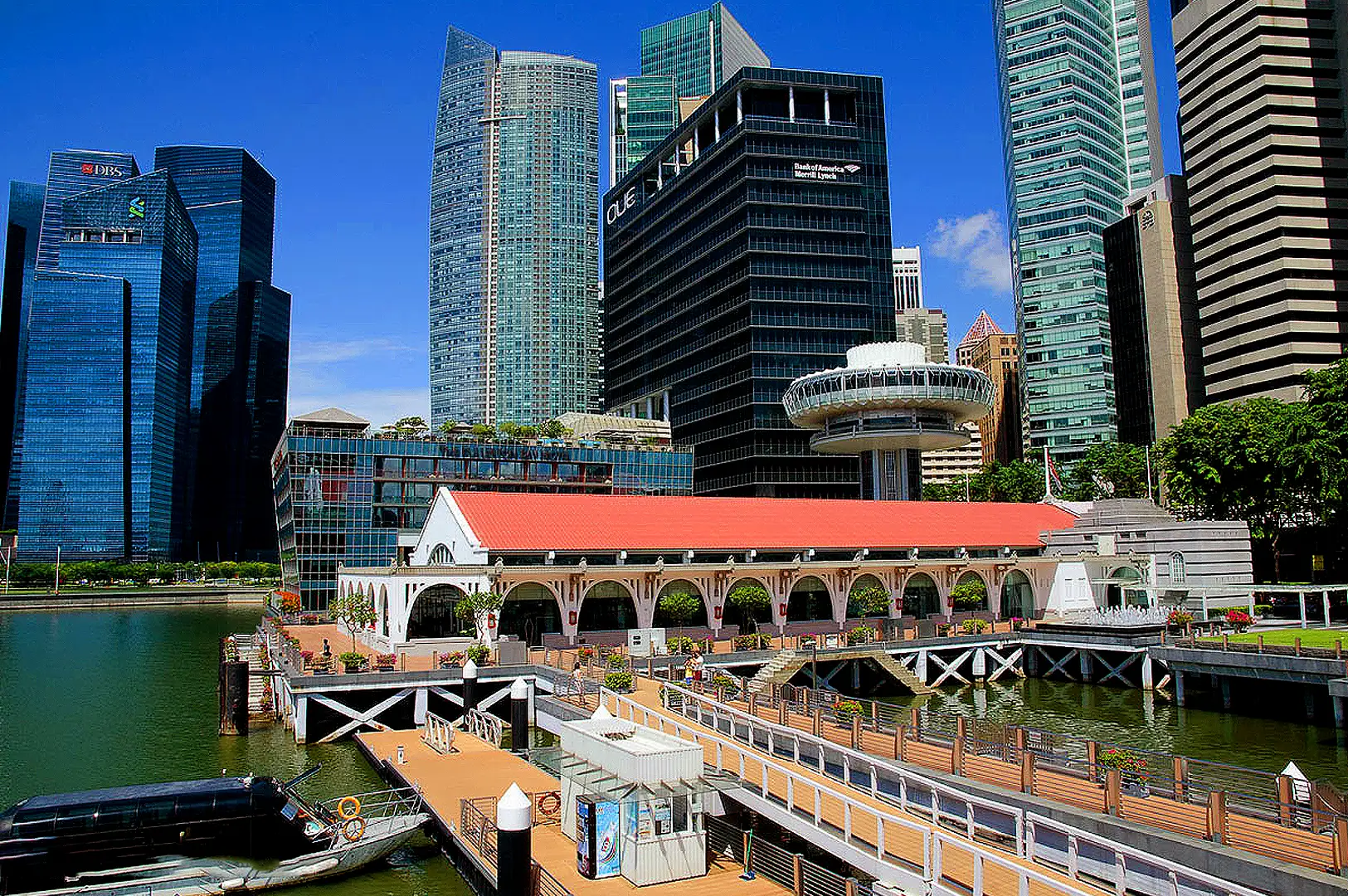
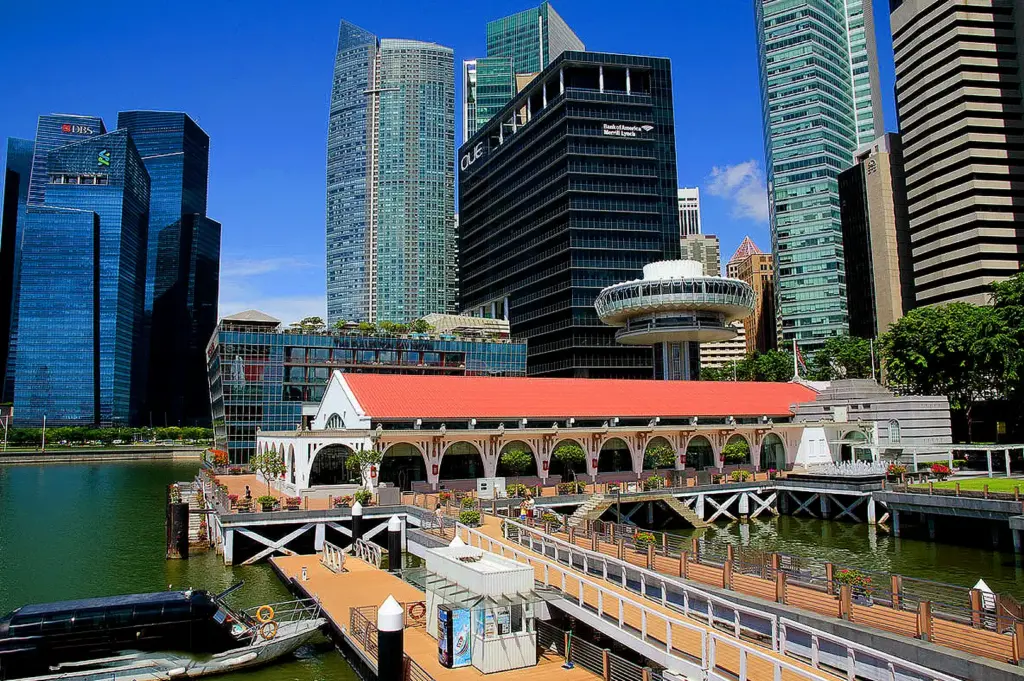
Along Collyer Quay, a low terracotta-brown roof interrupts the surrounding walls of glass and steel.
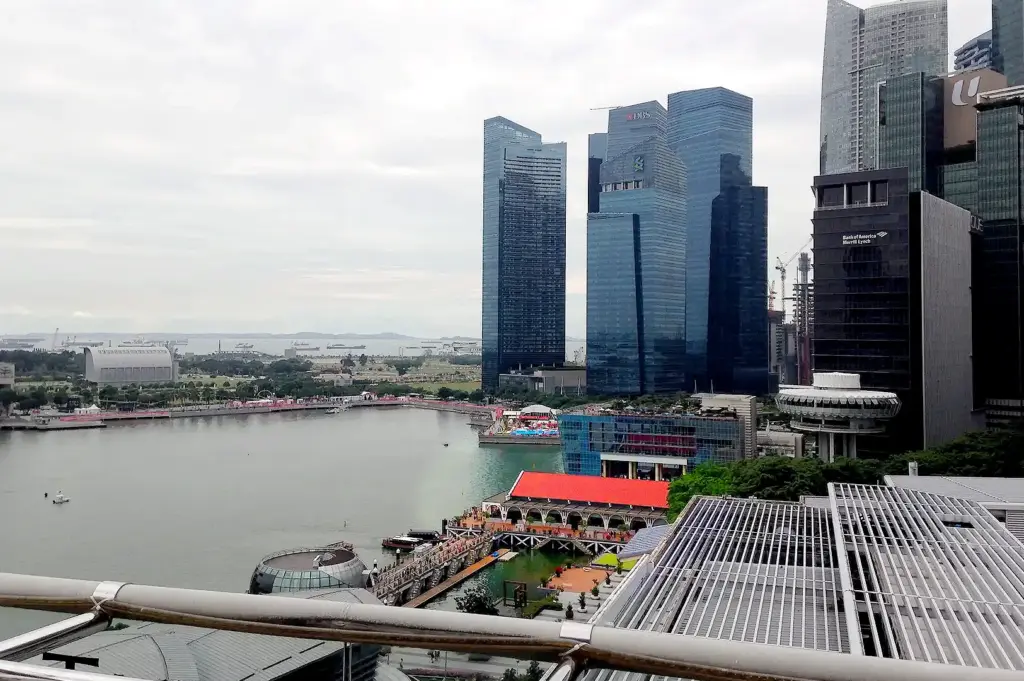
It belongs to Clifford Pier, a building whose modest height makes it easy to overlook from across Marina Bay. Behind it, the towers of the financial district rise sharply. Ahead lies the water, bordered by promenades and buildings that belong to a much newer chapter of Singapore.
The roof is particularly interesting. Its long, gently pitched form suggests a building designed to shelter people rather than compete with the skyline.
That distinction tells us something about why the pier was built.
Before it became part of The Fullerton Bay Hotel, Clifford Pier was a place of arrival and departure. Passengers stepped ashore here after travelling by sea, often transferring from larger vessels anchored offshore into smaller boats that carried them towards the city.
For many, this was one of their first encounters with Singapore.
Today, the movement is different. The boats no longer deliver passengers beneath the pier's roof. Yet its position along the waterfront still reveals the practical thinking behind its construction.
The building faces the water because the water was once its principal approach.
Completed in 1933, Clifford Pier replaced the older Johnston's Pier, which had served the harbour since the nineteenth century.
The new structure was designed by Frank Dorrington Ward, chief architect of Singapore's Public Works Department. Ward was also associated with several significant public buildings, including the former Supreme Court.
Clifford Pier was named after Sir Hugh Clifford, Governor of the Straits Settlements from 1927 to 1929.
But its official name was not the one by which everyone remembered it.
Locals knew the area as Ang Teng, meaning Red Lamp in Hokkien. The name referred to the red maritime lights that helped guide vessels towards the landing point, a tradition inherited from Johnston's Pier.
It is a detail that gives the building a more intimate history.
The red lamps were practical objects, yet they became part of how generations identified the waterfront. The roof's reddish-brown colour is another recognisable feature, but the pier's familiar nickname came from the lamps, not the roof.
Sometimes a place is remembered through the smallest thing that helped people find it.
The surviving architecture offers another way to understand the pier's former life.
Inside, the passenger hall is distinguished by a series of reinforced-concrete arches. Their curved members form a repeating, ribbon-like pattern across the ceiling, creating an unusually spacious interior.
There is a practical reason for this arrangement.
The arches support the roof without requiring columns to interrupt the central hall. For a busy passenger terminal, this meant people could move between the waterfront and the city with fewer obstacles.
The engineering also became part of the building's character.
Rather than concealing its structure, the design allows the concrete arches to establish the room's rhythm. Their repetition gives the space a sense of order, while the curved forms soften what might otherwise have been a purely functional terminal.
Art Deco influences appear in the geometric detailing, including the sunray motif around the entrance.
A coloured-glass fanlight adds another layer of craftsmanship. Its blue tones contrast with the warmer exterior roof, a small but considered detail in a building primarily associated with transport.
I find it revealing that so much attention was given to a place where people were expected to pass through rather than remain.
Clifford Pier was more than a waiting area.
Its open hall belonged to a working waterfront filled with movement between ships, smaller boats and the commercial streets behind Collyer Quay.
Passengers arrived with luggage. Sailors travelled between vessels and shore. Families made journeys to nearby islands. Goods, conversations and everyday routines passed through the same surroundings.
The building was therefore part of a wider relationship between Singapore and its harbour.
That relationship gradually changed.
As maritime facilities developed elsewhere and Marina Bay underwent extensive transformation, Clifford Pier's original purpose became less central to the city.
Boat services ended in 2006, closing more than seven decades of passenger operations.
The following year, on 14 March 2007, the pier was officially granted conservation status.
Its next chapter required a different kind of architectural decision.
Rather than demolishing the old terminal, the redevelopment incorporated Clifford Pier and the nearby former Customs Harbour Branch building into a new waterfront development centred on The Fullerton Bay Hotel.
The hotel opened in 2010.
The restoration retained significant features of the pier, including its distinctive concrete arches, coloured-glass fanlight and historic red lamps.
The original roof covering, which contained asbestos, was replaced with aluminium roofing in a terracotta-brown colour selected to recall the earlier appearance.
Other details received equally careful attention.
Decorative brackets, cast-iron rainwater pipes and textured finishes were repaired or restored. Glass was introduced behind parts of the existing façade to accommodate air-conditioning while preserving the character of the open hall.
These interventions changed how the building functioned without entirely removing the evidence of its earlier design.
Today, Clifford Pier forms part of the hotel's heritage complex, with its historic hall used for events rather than regular passenger services.
The restaurants at Marina Bay's waterfront reflect another chapter in the shoreline's history, where people now gather for meals and conversation rather than wait for boats to carry them ashore.
The change is considerable.
Where travellers once waited for boats, the building now accommodates gatherings of a different kind. Its relationship with the waterfront has become more visual than operational.
Yet the preservation of its structure allows something of the former experience to remain imaginable.
The wide interior still suggests movement. The roof continues to shelter a generous volume of space. The red lamps, restored and displayed within the building, recall a time when finding the pier mattered to people approaching from the sea.
Outside, the contrast with contemporary Marina Bay is particularly clear.
The Fullerton Bay Hotel's modern glass architecture sits beside the older pier, while the financial district rises behind both. From the promenade, their different proportions are visible within a short stretch of waterfront.
The pier belongs to a city that received people from the harbour. The newer buildings belong to one that has gradually turned much of that harbour frontage into civic, commercial and recreational space.
Neither history entirely disappears into the other.
That may be Clifford Pier's most interesting contribution to Marina Bay today.
It interrupts the apparent completeness of the modern skyline. Its roof reminds us that the waterfront had entrances, working routines and familiar names long before it became a place for photographs and evening walks.
From the water's edge, the building remains low against its neighbours.
Above the old landing point, the terracotta roof catches the daylight, while the towers behind it continue rising beyond the frame.